
Shoulder pain
Frozen shoulder and shoulder pain treatment without surgery
Shoulder (transarterial) embolization
Shoulder embolization treats frozen shoulder and some other chronic shoulder pain without surgery. Inflamed tissue in a painful shoulder grows extra tiny blood vessels that feed the pain. Through a pinhole in the wrist or groin, I block those vessels to calm the inflammation. You go home the same day and can start or continue physical therapy within days.
Who it's for
Shoulder embolization is usually worth considering if you:
- Have frozen shoulder (adhesive capsulitis) with pain and stiffness for three months or more
- Have chronic shoulder pain from tendon inflammation that hasn't improved with therapy
- Have pain that wakes you at night or keeps you from doing physical therapy
- Haven't gotten enough relief from physical therapy, anti-inflammatories or steroid injections
- Want to avoid or delay surgery
Who it may not be right for
Embolization isn't the right choice for a full-thickness rotator cuff tear that needs repair, severe shoulder arthritis, an unstable shoulder, or pain coming from the neck. It isn't done with an active infection. Before treatment I examine your shoulder and review your imaging, and if another option suits you better, I'll tell you.
How it works
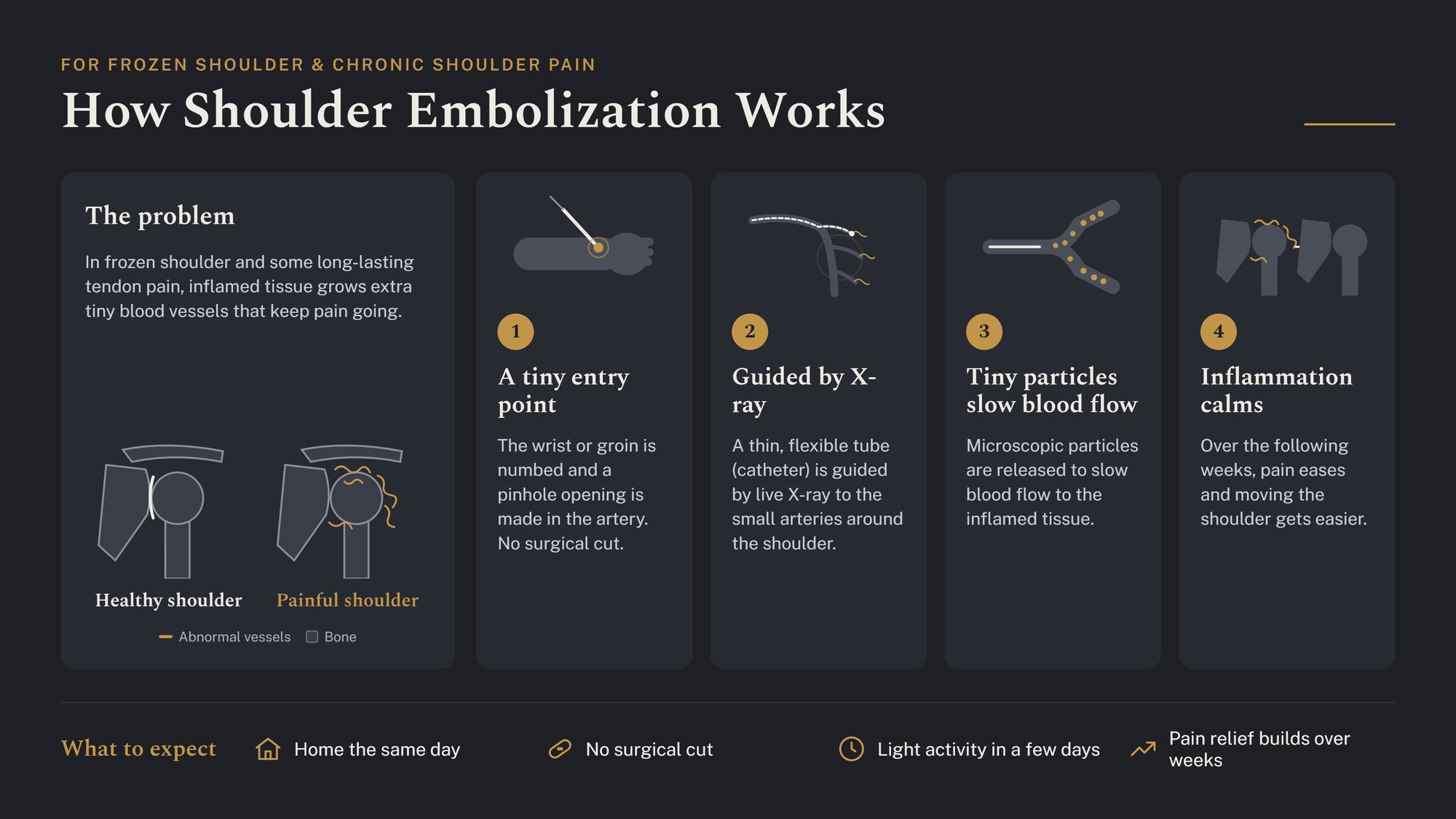
- I numb a spot on your wrist or groin and place a thin tube (catheter) into the artery.
- Using X-ray guidance, I steer it into the small arteries around the shoulder joint.
- I look for areas of abnormal blood flow in the inflamed capsule or tendons, then inject a temporary or permanent embolic agent to block them.
- Over the following weeks, inflammation settles and pain often eases, making therapy easier.
The procedure usually takes about an hour under light sedation. There is no incision and no stitches.
Shoulder embolization compared with the alternatives
| Physical therapy and medication | Steroid injection | Shoulder embolization | Arthroscopic surgery | |
|---|---|---|---|---|
| Anesthesia | None | Local | Light sedation | General plus a nerve block |
| Incision | None | None | None (pinhole) | Several small incisions |
| Back to normal | Not applicable | A day | A few days | Weeks, with rehab |
| How long relief lasts | Varies | Weeks to months | Months or longer in studies so far | Usually long-term |
| Keeps later options open | Yes | Yes | Yes | Not applicable |
Recovery
- Same day: You rest for a short time, then go home with someone driving you.
- First few days: Mild soreness at the access site or shoulder is common. Normal daily activity is fine.
- First few weeks: Start or resume physical therapy. Pain relief, if it comes, often lets you push further in therapy.
- Follow-up: We check in at about one and three months.
Results and risks: what the evidence shows
In a study comparing shoulder embolization with arthroscopic surgery for frozen shoulder, both groups improved in pain, motion and function. The embolization group had less pain at three months, and by six months the two groups were about the same (Wang et al., J Shoulder Elbow Surg 2026). Reviews of the published studies report technical success close to 100% and few side effects (Ubaldi et al., Front Radiol 2026).
To be straightforward: most studies so far are small and didn't compare embolization with a placebo procedure, so the true size of the benefit is still being worked out, and experts are still standardizing how it is done (Fernández-Martínez et al., CVIR 2025). Side effects are usually minor, such as bruising at the access site or temporary redness of the skin over the shoulder.
Cost and insurance
Many insurers still consider shoulder embolization investigational, so coverage is inconsistent. The clinic checks your plan and gives you a clear cost estimate before you decide.
Common questions
Doesn't my shoulder need its blood flow?
Yes, and it keeps it. I'm not cutting off the blood flow to your shoulder. The inflamed tissue has built up extra blood flow, well beyond what a healthy shoulder has, and that extra flow feeds the inflammation and pain. Embolization turns it back down toward a normal amount. The muscles, tendons and bone keep their normal supply.
How can blocking blood vessels help shoulder pain?
In frozen shoulder and some other chronic shoulder problems, the inflamed tissue grows extra small blood vessels, and nerve fibers grow along with them. Those vessels and nerves are thought to drive much of the pain. Blocking them calms the inflammation without harming the normal blood supply to the shoulder.
Will it help me move my shoulder better?
In frozen shoulder, pain relief often makes it possible to do physical therapy that was too painful before, and motion usually improves along with it. Physical therapy after embolization is an important part of the plan.
How soon will I notice a difference?
Some people notice less pain, especially at night, within days to a few weeks. Improvement usually continues over the following months.
Is this a new treatment?
Shoulder embolization has been studied for about a decade, mostly in Japan and Europe and now in the U.S. The results so far are encouraging, but the studies are mostly small and large randomized trials are still needed. I will be clear with you about that.
Is shoulder embolization covered by insurance?
Many insurers still consider it investigational, so coverage is inconsistent. The clinic checks your plan and gives you a clear cost estimate before you decide. Call 701-364-4010.
Next step
Call 701-364-4010 to set up a consultation at Vascular & Interventional Specialists of Fargo. Bring any shoulder X-rays or MRI reports, and a list of treatments you've tried, such as physical therapy and injections.