
Knee osteoarthritis
Knee arthritis pain treatment without surgery
Genicular artery embolization (GAE), also called knee embolization
Genicular artery embolization (GAE) treats knee arthritis pain without surgery. In an arthritic knee, the inflamed joint lining grows extra small blood vessels that drive pain. Through a pinhole, I block those vessels to calm the inflammation. It is done under light sedation, you walk out the same day, and most people are back to normal activity within a few days.
Call 701-364-4010 to book a consultation
Watch: what to expect with GAE

Who it's for
GAE is usually worth considering if you:
- Have had moderate to severe knee pain from arthritis for at least three months
- Haven't gotten enough relief from physical therapy, anti-inflammatories or injections
- Aren't ready for a knee replacement, or have health problems that make surgery riskier
- Still have pain after a knee replacement, once infection and a loose implant have been ruled out
Who it may not be right for
GAE isn't recommended if you have an active knee infection, a problem that needs surgical repair, or severe blockages in the leg arteries. It tends to help less in very advanced, bone-on-bone arthritis. Before treatment I review your X-rays and sometimes an MRI, and if another option suits you better, I'll tell you.
How it works
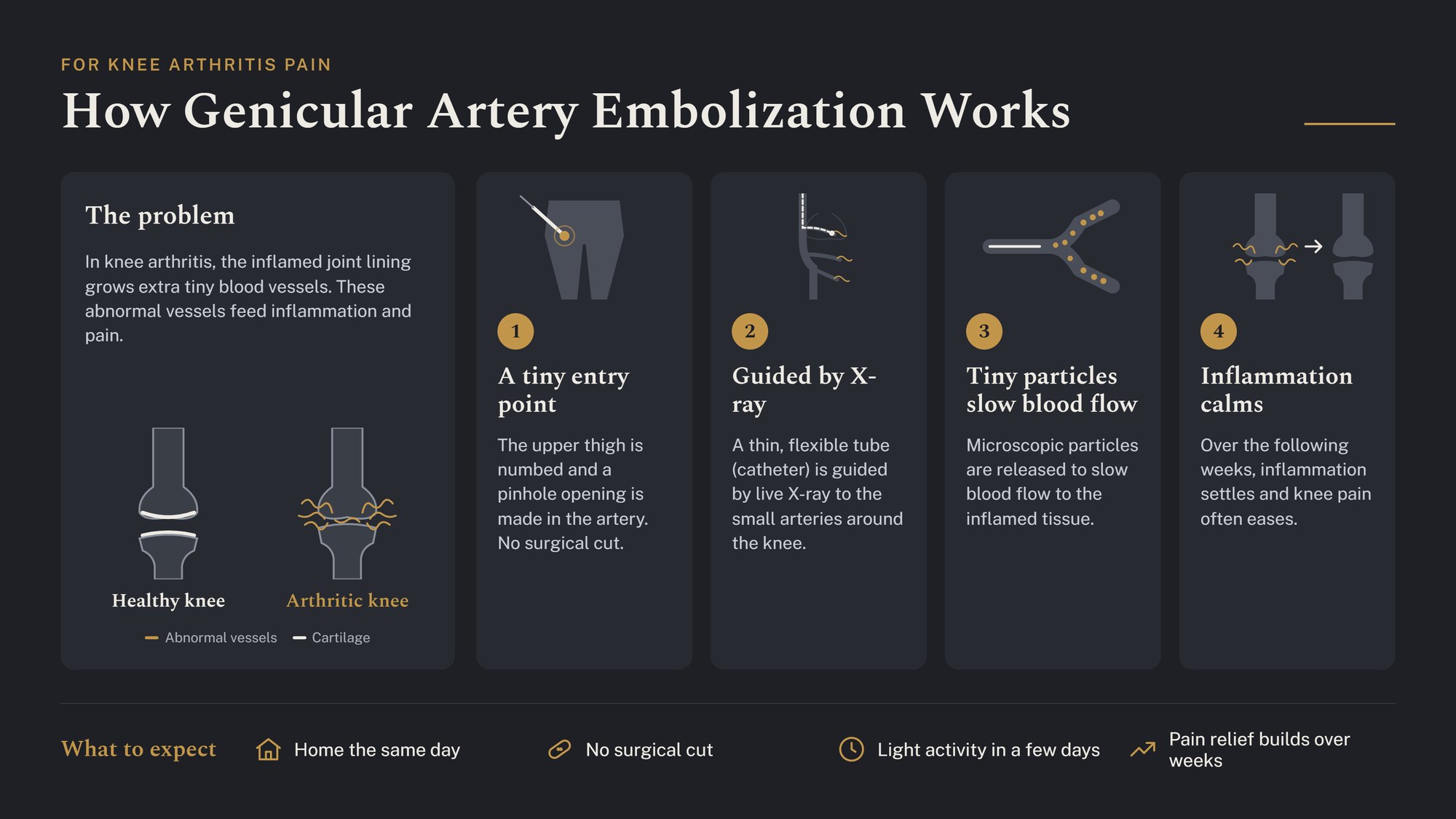
- I numb a spot on your groin or wrist and place a thin tube (catheter) into the artery.
- Using X-ray guidance, I steer it to the small genicular arteries around the knee.
- I look for the areas of abnormal blood flow in the inflamed joint lining, then inject tiny particles to block them.
- Over the following weeks, inflammation settles and pain often eases.
The procedure usually takes one to two hours. There is no incision and no stitches.
GAE compared with the alternatives
| Physical therapy and medication | Knee injections | Genicular artery embolization | Knee replacement | |
|---|---|---|---|---|
| Anesthesia | None | Local | Light sedation | General or spinal |
| Hospital stay | None | None | Home same day | Often 1–2 days |
| Recovery | None | A day or two | A few days | Several months of rehab |
| How long relief lasts | While continued | Weeks to months | Months, sometimes a year or more; varies | Long-term for most people |
| Changes the joint | No | No | No | Yes, replaces it |
| Keeps later options open | Yes | Yes | Yes | Not applicable |
Recovery
- Same day: You rest for a few hours, then go home with someone driving you.
- First few days: Mild soreness or bruising is common. Light walking is encouraged; avoid strenuous activity.
- First few weeks: Some people notice the skin over the knee looks blotchy for a while. This usually fades on its own.
- One to three months: Pain relief, if it comes, usually builds over this time. We check in with a follow-up visit.
Results and risks: what the evidence shows
The Society of Interventional Radiology describes GAE as a joint-preserving option for the gap between conservative care and knee replacement (SIR position statement, JVIR 2026). Across 18 studies and 534 patients, pain scores dropped by about 4 points on a 10-point scale, and the improvement lasted through a year (Alves et al., Skeletal Radiology 2026).
I want to be straightforward with you: most of those studies didn't compare GAE with a placebo procedure. Of three trials that did, one showed a clear benefit and two did not show a significant difference (Milhem et al., J Orthop 2025; van Zadelhoff et al., 2025). Larger trials are under way.
Serious complications have been rare in these studies. The most common side effects are bruising at the access site and temporary skin discoloration over the knee.
Cost and insurance
Coverage for GAE is still inconsistent, and many insurers consider it investigational. The clinic checks your plan and gives you a clear cost estimate before you decide.
Common questions
Doesn't my knee need its blood flow?
Yes, and it keeps it. I'm not cutting off the blood flow to your knee. The inflamed lining has built up extra blood flow, well beyond what a healthy knee has, and that extra flow feeds the inflammation and pain. Embolization turns it back down toward a normal amount. The bones, cartilage and other tissues keep their normal supply.
Does GAE really work?
Many patients in published studies reported large, lasting drops in knee pain. But trials that compared GAE with a sham (placebo) procedure have had mixed results, so the true size of the benefit is still being studied. I will give you a realistic sense of your chances based on your X-rays and symptoms.
Who is not a candidate for GAE?
GAE is not a good fit if you have an active infection, a knee problem that needs surgical repair (like a loose implant or a torn ligament), or severe blockages in the leg arteries. It also tends to work less well in very advanced, bone-on-bone arthritis.
Can GAE help if I still have pain after a knee replacement?
Sometimes. Once problems like infection or a loose implant are ruled out, GAE can be an option for ongoing pain after a knee replacement. Some people need a second treatment to get the full benefit.
What are the disadvantages of GAE?
Not everyone responds, and some people need a repeat treatment. Side effects are usually minor, such as bruising at the access site or temporary skin discoloration over the knee. Serious complications are rare.
Will GAE stop me from having a knee replacement later?
No. GAE does not change the joint itself, so a knee replacement is still an option later if you need one.
How much does GAE cost? Is it covered by insurance?
Coverage for GAE is still inconsistent, and many insurers consider it investigational. The clinic checks your plan and gives you a clear cost estimate before you decide. Call 701-364-4010.
Next step
Call 701-364-4010 to set up a consultation at Vascular & Interventional Specialists of Fargo. Bring any recent knee X-rays or MRI reports, and a list of the treatments you've already tried.