
Hemorrhoids
Bleeding hemorrhoid treatment without surgery
Hemorrhoid artery embolization (rectal artery embolization)
Hemorrhoid artery embolization treats bleeding internal hemorrhoids by reducing the blood flowing into them. Through a pinhole in the wrist or groin, I block the small arteries that feed the hemorrhoids. Nothing is done near the anus, you go home the same day, and most people are back to normal activity within a day or two.
Who it's for
Hemorrhoid embolization is usually worth considering if you:
- Have internal hemorrhoids that bleed, especially if the bleeding has caused low blood counts
- Still have bleeding after fiber, creams, banding or other office treatments
- Take blood thinners, or have health problems that make surgery riskier
- Want to avoid the pain and recovery of hemorrhoid surgery
Who it may not be right for
Rectal bleeding has other causes, including colon cancer, so you need an up-to-date colonoscopy or other evaluation first. Embolization isn't the right choice for external hemorrhoids, a blood clot in a hemorrhoid, or hemorrhoids that stay prolapsed, and it is not done during pregnancy. I work alongside your primary care provider, gastroenterologist or surgeon.
How it works
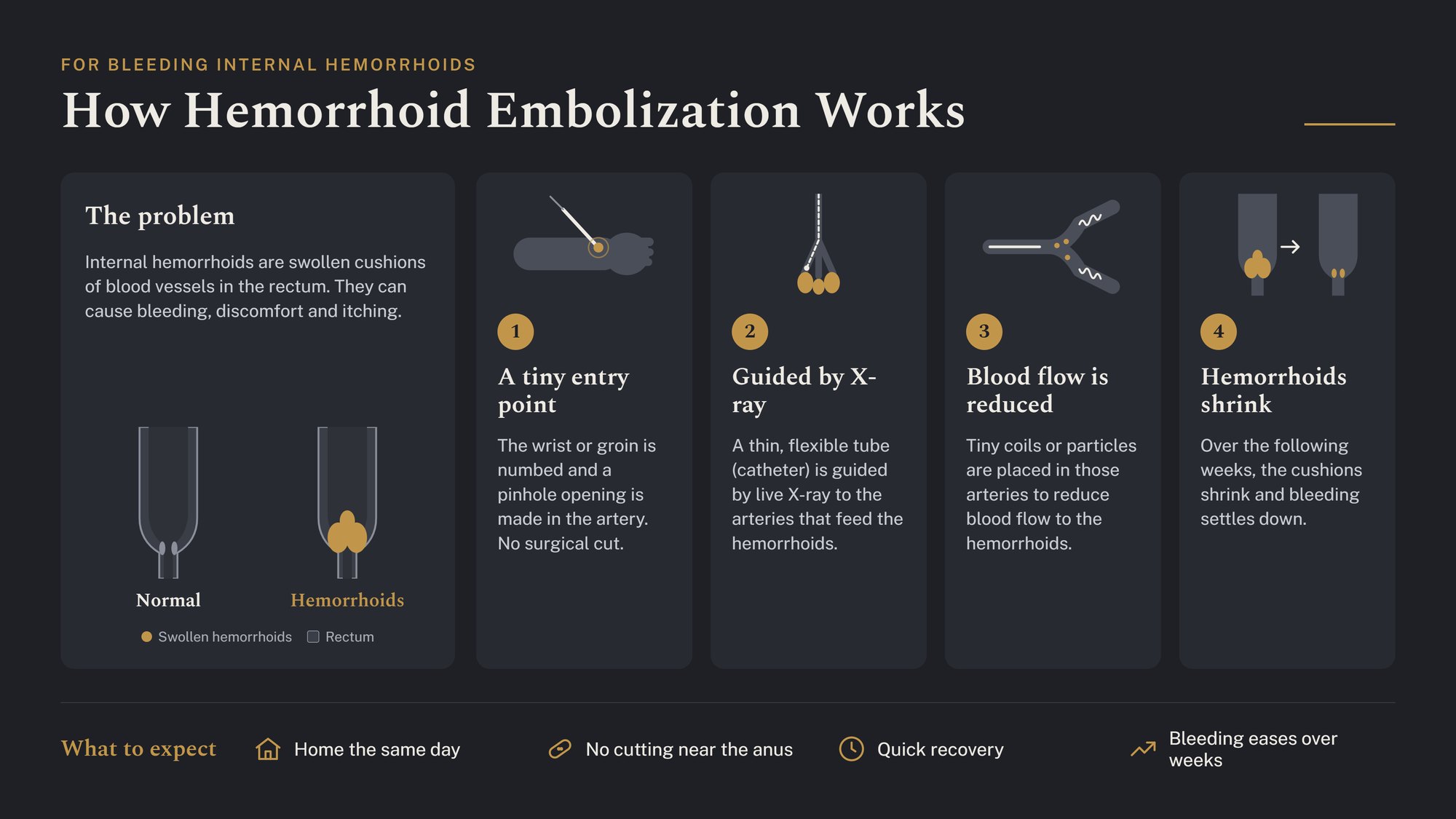
- I numb a spot on your wrist or groin and place a thin tube (catheter) into the artery.
- Using X-ray guidance, I steer it into the arteries that supply the rectum.
- I block the small branches feeding the hemorrhoids with tiny coils or particles. The rectum keeps its blood supply from other arteries.
- Over the following weeks, the hemorrhoids bleed less and shrink.
The procedure usually takes about an hour. There is no incision and no stitches.
Embolization compared with the alternatives
| Banding | Hemorrhoid artery embolization | Hemorrhoid surgery | |
|---|---|---|---|
| Where treatment happens | At the hemorrhoid | Through an artery at the wrist or groin | At the anus |
| Anesthesia | None | Light sedation | Usually general or spinal |
| Pain afterward | Mild to moderate | Usually mild | Often significant for 1–2 weeks |
| Back to normal | A day or two | A day or two | About 2–4 weeks |
| Sessions needed | Often several | Usually one; some need a repeat | Usually one |
| Best for | Smaller bleeding hemorrhoids | Bleeding internal hemorrhoids | Large or prolapsed hemorrhoids |
Recovery
- Same day: You rest for a few hours, then go home with someone driving you.
- First few days: Some people have mild rectal or pelvic discomfort, an urge to have a bowel movement, or a low-grade fever. These settle on their own.
- First few weeks: Bleeding usually decreases over this time. Keep up fiber and fluids to avoid straining.
- Follow-up: We check in at about a month and again later to make sure the bleeding has settled.
Results and risks
A review of 22 studies covering 810 procedures found the procedure succeeded technically in 93–100% of cases, and bleeding and symptoms improved meaningfully in 63–94% of patients. Side effects were mild and short-lived, such as pelvic discomfort, nausea or a low fever, with no cases of damage to the rectum, loss of bowel control or death. Bleeding returned and needed another treatment in 8–20% of patients, usually because of extra arteries feeding the hemorrhoids (Al Jnainati et al., Int J Colorectal Dis 2025).
This is a newer treatment, and most studies are small. It hasn't yet been compared head-to-head with banding or surgery in large trials, which is why I see it as an option between office treatments and surgery rather than a replacement for either.
Cost and insurance
Coverage varies by plan. The clinic checks your benefits, handles any prior authorization and gives you an estimate before you schedule.
Common questions
Doesn't the rectum need that blood flow?
Hemorrhoids bleed because too much blood is flowing into them under pressure. Embolization turns down that pressure, so the hemorrhoids shrink and the bleeding stops. The surrounding rectal tissue keeps getting blood from smaller arteries that aren't treated.
How is this different from banding or surgery?
Banding and surgery work on the hemorrhoid itself, from below. Embolization works from inside the arteries, reducing the blood flowing into the hemorrhoids so they bleed less and shrink. Nothing is done in or near the anus, so there is usually little pain afterward.
Does it work for every kind of hemorrhoid?
It works best for internal hemorrhoids that bleed. It does not treat external hemorrhoids, skin tags, or hemorrhoids that hang out all the time, which are better treated by a surgeon.
Can I have it if I take blood thinners?
Often yes. Embolization can be a good option for people on blood thinners or with other health problems that make surgery riskier. We will go over your medications before the procedure.
Will it affect bowel control?
No loss of bowel control has been reported in the published studies. The muscles that control the bowels are not touched.
Is hemorrhoid embolization covered by insurance?
Coverage varies by plan. Many plans cover it for bleeding hemorrhoids that haven't responded to other treatment, sometimes with prior authorization. Call 701-364-4010.
Next step
Call 701-364-4010 to set up a consultation at Vascular & Interventional Specialists of Fargo. Bring the report from your most recent colonoscopy, and a list of the hemorrhoid treatments you've already tried.