
Heel pain
Plantar fasciitis and heel pain treatment without surgery
Plantar fasciitis embolization
Embolization is a newer option for plantar fasciitis heel pain that hasn't improved after months of stretching, shoes, inserts or injections. Long-lasting heel pain is linked to extra tiny blood vessels growing in the damaged tissue. Through a pinhole, I block those vessels to calm the pain. You walk out the same day.
Who it's for
Plantar fasciitis embolization may be worth considering if you:
- Have had heel pain from plantar fasciitis for six months or more
- Have sharp pain with your first steps in the morning or after sitting
- Haven't improved with stretching, supportive shoes, inserts, night splints, physical therapy, shock wave therapy or injections
- Want to avoid surgery on the fascia
Who it may not be right for
Most plantar fasciitis improves without any procedure, so embolization is only for pain that has lasted. It isn't recommended if you have severe blockages in the leg arteries, an infection in the foot, or heel pain from another cause such as a stress fracture or a pinched nerve. Before treatment I review your exam and imaging, and check the blood flow to your foot.
How it works
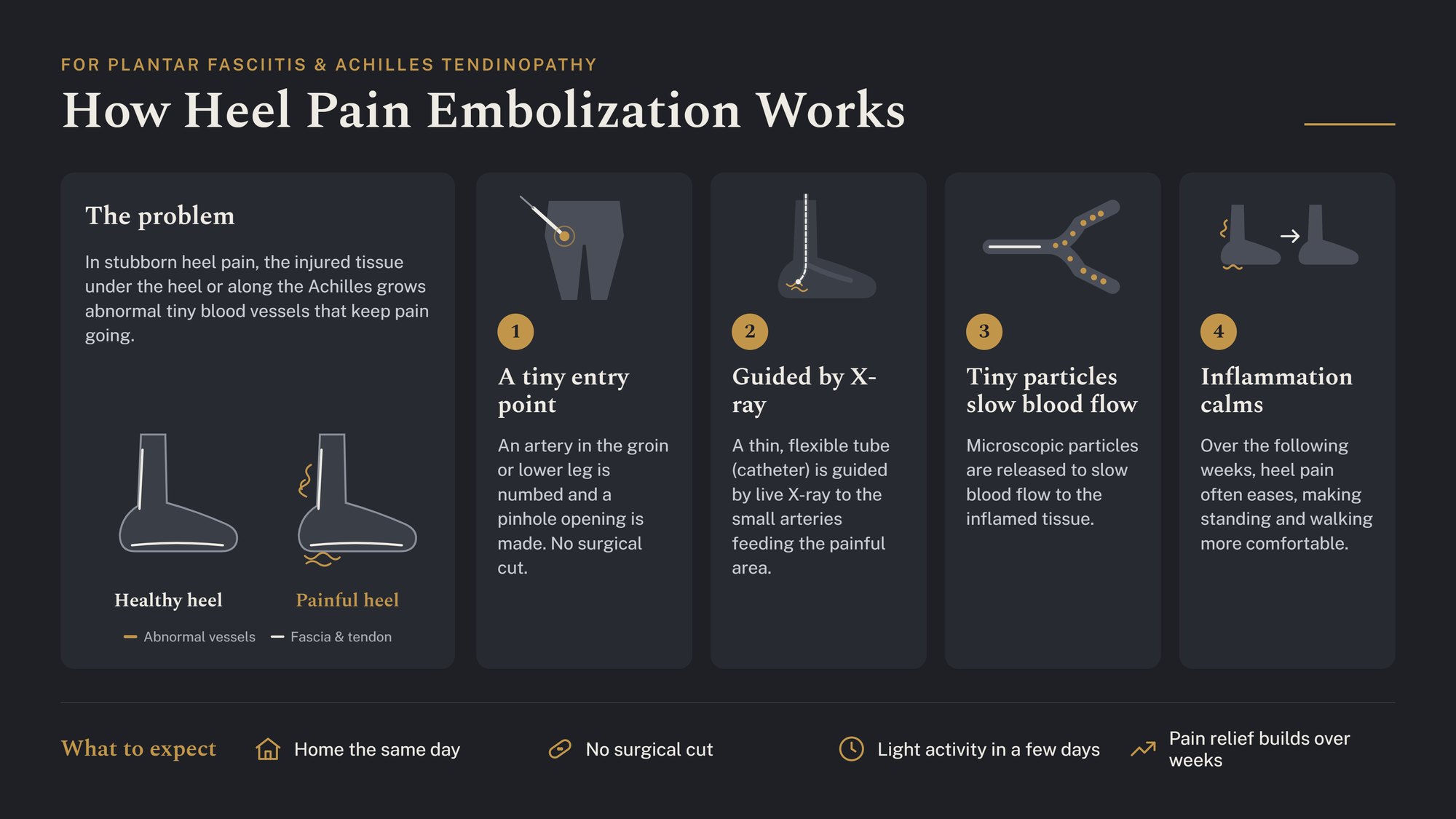
- I numb a spot over the artery in the groin and place a thin tube (catheter).
- Using X-ray guidance, I steer it into the small arteries of the heel.
- I look for the area of abnormal blood flow near where the fascia attaches to the heel bone, then inject an embolic agent to block it.
- Over the following weeks, heel pain often eases.
The procedure usually takes under an hour under light sedation. There is no incision and no stitches.
Recovery
- Same day: You walk out and go home with someone driving you.
- First few days: Mild soreness at the access site is common. Normal walking is fine.
- First few weeks: Keep up stretching and supportive shoes. Return to running or high-impact activity gradually.
- Follow-up: We check in at about one and three months.
Results and risks: what the evidence shows
I want to be clear that this is an early treatment. The published studies are small. In one, all 10 patients with plantar fasciitis that hadn't responded to conservative care had lasting pain relief through six months (Gandhi and Banker, Br J Radiol 2024). In another, 12 patients had average pain scores fall from about 7 to about 1.4 out of 10 at six months, though about half needed a second, more targeted treatment (Porcaro et al., Healthcare 2026). No serious complications were reported in these studies.
There are no large or placebo-controlled trials yet. Over 80% of people with plantar fasciitis get better with non-surgical treatment (Tseng et al., J Med Ultrasound 2023), so embolization is for the people who don't. Possible side effects include bruising at the access site and temporary skin changes or numbness on the heel.
Cost and insurance
Most insurers consider plantar fasciitis embolization investigational, so it is often not covered. The clinic checks your plan and gives you a clear cost estimate before you decide.
Common questions
Doesn't my foot need its blood flow?
Yes, and it keeps it. I'm not cutting off the blood flow to your heel. The irritated tissue has built up extra blood flow, well beyond what a healthy heel has, and that extra flow feeds the inflammation and pain. Embolization turns it back down toward a normal amount. The skin, fat pad, muscles and bone keep their normal supply. I check the blood flow to your foot before treatment to make sure it's safe.
How does embolization help plantar fasciitis?
In long-lasting plantar fasciitis, the damaged tissue where the fascia attaches to the heel grows extra tiny blood vessels, with nerve fibers alongside them. Blocking those vessels is thought to reduce the pain signals and allow the tissue to settle.
Should I try this before surgery?
Most plantar fasciitis gets better with stretching, supportive shoes, inserts, night splints and time. For the smaller group who still have pain after many months, embolization is an option to consider before surgery, especially if you want to avoid cutting the fascia.
Can it help Achilles tendon pain?
Embolization has also been used for chronic Achilles tendon pain and other overuse tendon problems, but the evidence is even more limited. We can talk about whether it makes sense for you.
How soon can I walk?
You walk out the same day. Most people go back to normal walking right away and return to running or high-impact activity gradually over a few weeks.
Is plantar fasciitis embolization covered by insurance?
Most insurers consider it investigational, so it is often not covered. The clinic checks your plan and gives you a clear cost estimate before you decide. Call 701-364-4010.
Next step
Call 701-364-4010 to set up a consultation at Vascular & Interventional Specialists of Fargo. Bring any foot X-ray, ultrasound or MRI reports, and a list of the treatments you've already tried.