
Enlarged prostate (BPH)
Enlarged prostate treatment without surgery
Prostatic artery embolization (PAE)
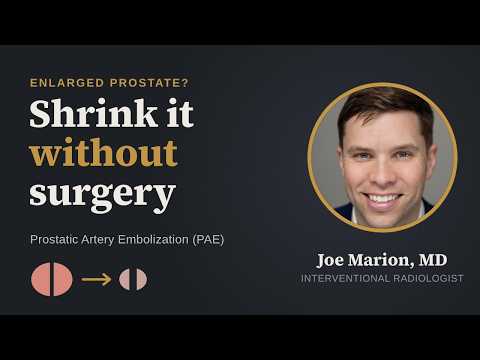
Prostatic artery embolization (PAE) treats an enlarged prostate without surgery. Through a pinhole in the wrist or groin, I block the small arteries feeding the prostate so it shrinks over the following weeks. It is done under light sedation, you go home the same day, and most men are back to normal activity within a few days.
Call 701-364-4010 to book a consultation
Watch: what to expect with PAE
Who it's for
PAE is usually a good fit if you:
- Get up at night to urinate, have a weak stream, or feel like you never fully empty
- Haven't done well on medications like tamsulosin or finasteride, or don't like their side effects
- Want to avoid surgery, or have health problems that make surgery riskier
- Have a large prostate (over about 60 grams), which some other office procedures can't treat
- Have bleeding from the prostate that keeps coming back
Who it may not be right for
PAE may not be the best choice if you have prostate cancer, severe kidney problems that limit the use of contrast dye, or very hardened, twisted arteries. Before treatment I review your imaging, PSA and symptom score, and if another option suits you better, I'll tell you.
How it works
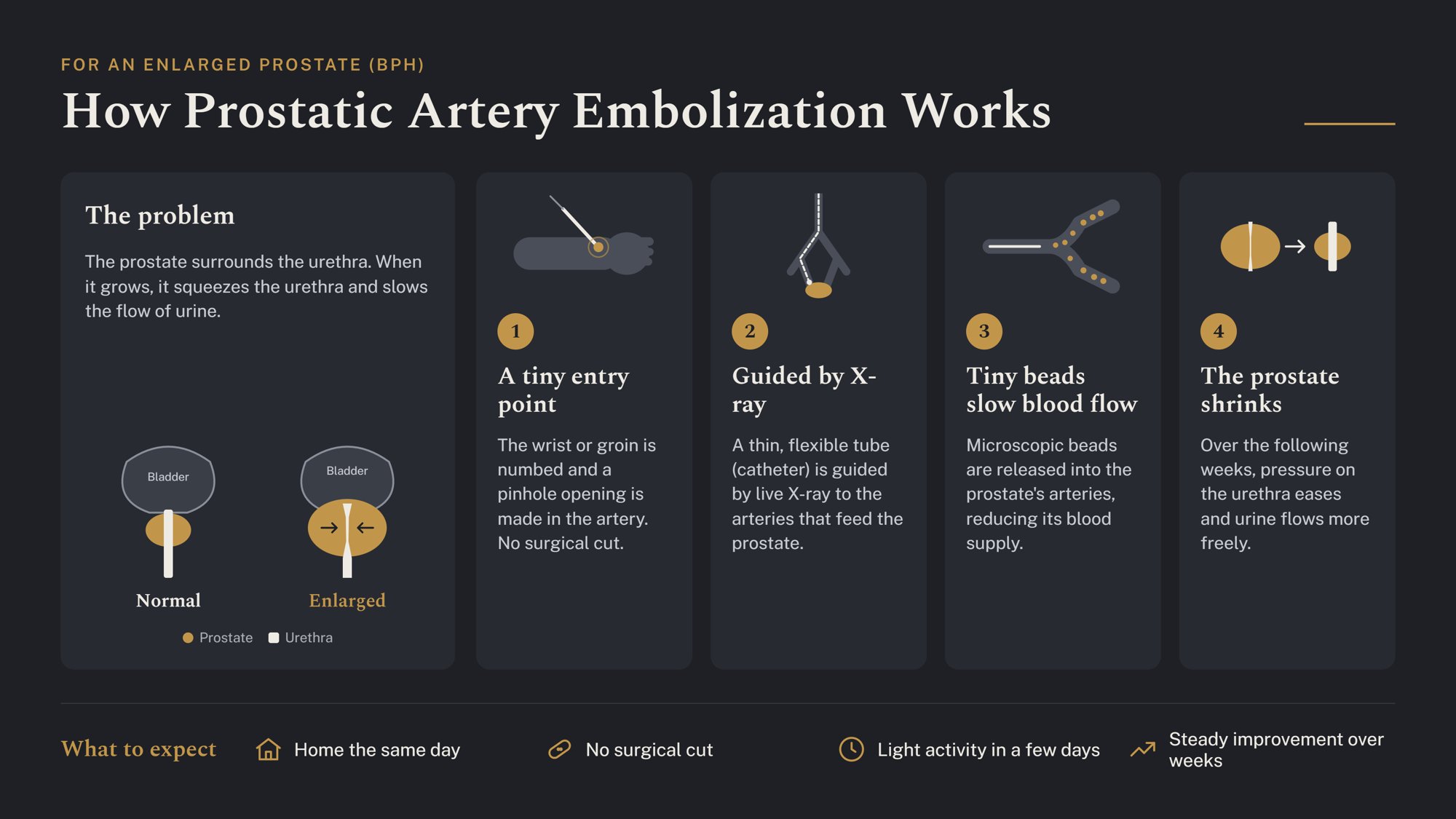
- I numb a spot on your wrist or groin and place a thin tube (catheter) into the artery.
- Using X-ray guidance, I steer it to the small arteries that feed the prostate on each side.
- I inject tiny particles that slow blood flow to the prostate.
- Over the next several weeks, the prostate softens and shrinks, easing pressure on the urethra.
The procedure usually takes one to three hours. There is no incision and no stitches.
PAE compared with the alternatives
| Medications | PAE | Office lift or steam procedures | TURP / laser surgery | |
|---|---|---|---|---|
| Anesthesia | None | Light sedation | Local or light sedation | General or spinal |
| Hospital stay | None | Home same day | Home same day | Often overnight |
| Catheter afterward | No | Usually not | Often a few days | Usually 1–3 days |
| Very large prostates | Limited | Yes | Limited by size | Yes |
| Effect on ejaculation | Some cause it | Rarely affected | Rarely affected | Often affected |
| Strength of effect | Mild to moderate | Moderate to strong | Moderate | Strongest |
Recovery
- Same day: You rest for a few hours, then go home with someone driving you.
- First week: Burning, frequent urination or pelvic ache are common and usually mild. Avoid heavy lifting for a few days.
- Two to four weeks: Many men start noticing a stronger stream and fewer nighttime trips.
- Three months: Most of the improvement is in place. We check in with a follow-up visit.
Results and risks
A pooled analysis of early studies found large improvements in symptom scores and quality of life a year after PAE, with serious complications in well under 1% of men and no decline in erectile function (Uflacker et al., JVIR 2016). A 2023 network analysis of randomized trials found symptom and quality-of-life improvements after PAE similar to TURP, while TURP improved urine flow more (Cornu et al., European Urology 2023).
Minor side effects are common: temporary burning, frequency, blood in the urine or semen, and occasionally a short spell of urinary retention. Some men need a repeat treatment or surgery years later (Bilhim, Semin Intervent Radiol 2022; Altman et al., BMC Urology 2024).
Cost and insurance
Medicare and many commercial plans cover PAE when symptoms come from an enlarged prostate. The clinic verifies your coverage and gives you an estimate of your share before you schedule.
Common questions
Don't I need blood flow to my prostate?
Think of it as putting the prostate on a diet. I block the small arteries that bring oxygen and nutrition to the overgrown prostate tissue, so it shrinks and stops squeezing the urethra. The bladder, rectum and nearby organs have their own separate blood supply and aren't affected.
Will PAE affect my sex life?
Studies have not found a drop in erectile function after PAE, and it does not cause the "dry" orgasm that is common after TURP. That is one of the main reasons men choose it.
Does it hurt?
The procedure itself is done with numbing medicine and light sedation. For a few days afterward, many men have burning with urination, more frequent urination, or an ache in the pelvis. These are usually mild and settle on their own.
How soon will I notice a difference?
Some men notice improvement within a couple of weeks. Because the prostate shrinks gradually, the full effect usually takes about three months.
Is PAE as good as TURP?
TURP improves urine flow measurements more. PAE improves symptoms and quality of life to a similar degree in many studies, with fewer complications and no hospital stay. Some men later need a second treatment. I will go through which fits you better.
Is PAE covered by insurance?
Medicare and many commercial plans cover PAE for men with symptoms from an enlarged prostate. Coverage varies by plan, so the clinic checks your benefits before scheduling.
Do I need a referral?
Depending on your insurance, you may be able to book a consultation directly. Call 701-364-4010.
Next step
Call 701-364-4010 to set up a consultation at Vascular & Interventional Specialists of Fargo. Bring a list of your medications and any recent PSA results or prostate imaging.