
Spine compression fractures
Spine compression fracture treatment
Kyphoplasty and vertebroplasty
Kyphoplasty treats painful spine fractures caused by osteoporosis. Through a needle in the back, I place medical bone cement into the broken vertebra to stabilize it. It is done under sedation in about an hour, most people go home the same day, and many feel less pain within a day or two.
Who it's for
Kyphoplasty is usually worth considering if you:
- Have a compression fracture from osteoporosis that is still painful
- Have pain that limits walking, sitting, sleeping or getting out of bed
- Haven't improved enough with pain medication, a brace and rest, or can't tolerate pain medication
- Have an MRI or bone scan showing the fracture is recent and still healing
Who it may not be right for
Kyphoplasty isn't recommended if the fracture has already healed, if your pain is coming from somewhere else in the spine, if there is an infection, or if bone fragments are pressing on the spinal cord or nerves. Before treatment I review your imaging and examine your back to make sure the fracture is the source of your pain.
How it works
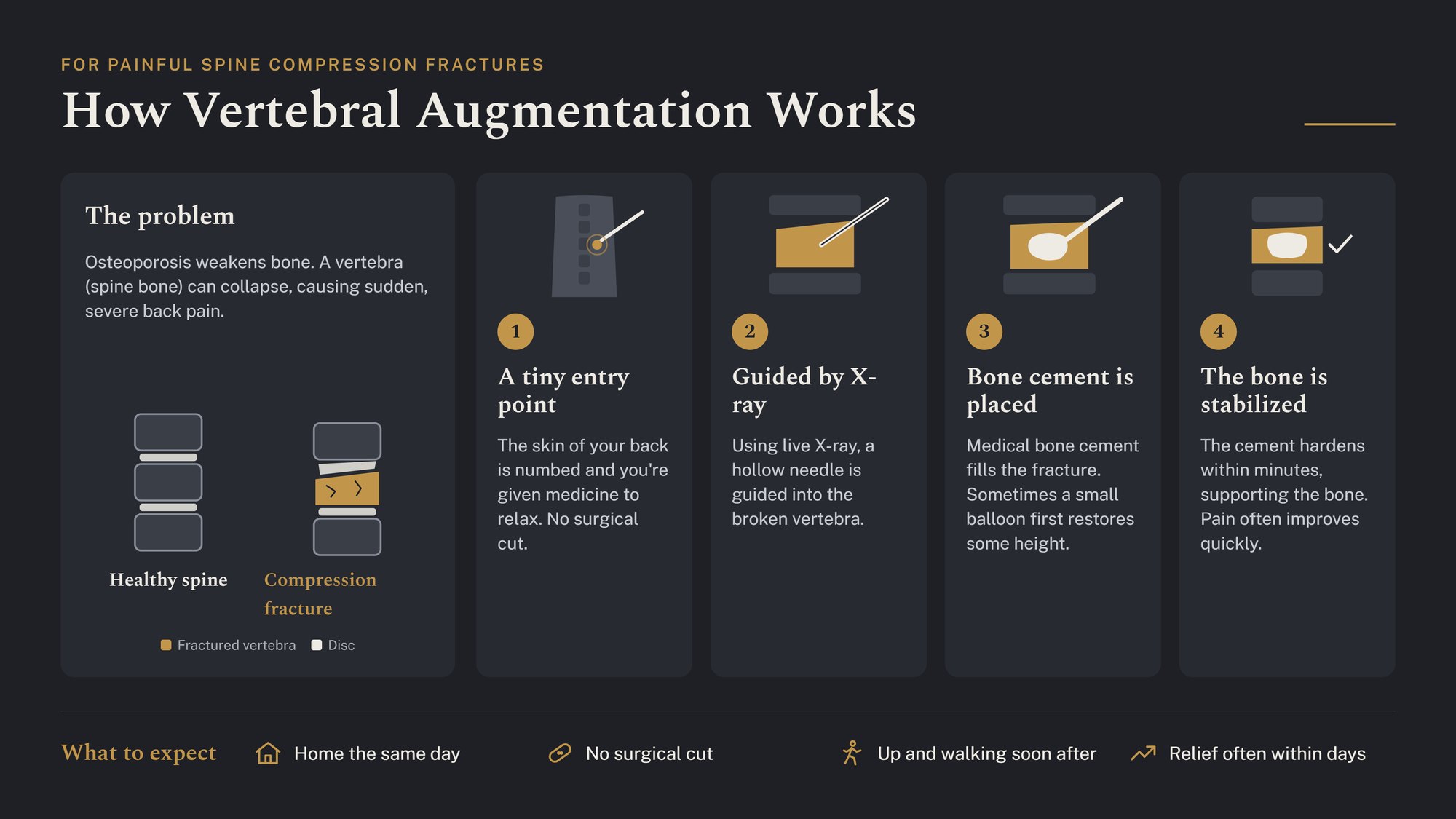
- You lie on your stomach and receive sedation, and the skin over the fracture is numbed.
- Using X-ray guidance, I pass a needle through the back into the broken vertebra.
- For kyphoplasty, a small balloon is inflated inside the bone to create a space, then removed.
- Bone cement is injected and hardens within minutes, stabilizing the fracture.
Treating one level usually takes less than an hour. There is no incision, just a small nick that is covered with a bandage.
Kyphoplasty compared with the alternatives
| Medication, brace and rest | Kyphoplasty or vertebroplasty | Open spine surgery | |
|---|---|---|---|
| Anesthesia | None | Sedation or light anesthesia | General |
| Hospital stay | None, unless pain requires admission | Usually home same day | Several days |
| Pain relief | Gradual, over weeks to months | Often within days | Variable |
| Used for | Most fractures, at first | Painful fractures not improving | Unstable fractures or nerve compression |
Recovery
- Same day: You lie flat for a short time while the cement fully sets, then get up and walk. Most people go home the same day.
- First few days: Soreness where the needle went in is common and fades quickly. You can return to light activity right away.
- Afterward: Treating the osteoporosis matters as much as treating the fracture. We make sure you have a plan with your primary care provider or endocrinologist.
Results and risks: what the evidence shows
In a randomized trial of 300 patients with recent fractures, those who had kyphoplasty had better quality of life and less pain at one month than those treated with medication and rest alone, with no difference in the rate of side effects (Wardlaw et al., Lancet 2009).
To be fair, the evidence is not one-sided. A trial comparing vertebroplasty with a sham procedure that used only numbing medicine found that both groups improved about equally (Firanescu et al., BMJ 2018). Because results vary between studies, choosing the right fracture and the right time matters. It works best for people with recent, painful fractures who are not getting better on their own.
Serious complications are uncommon. Cement can leak outside the bone, which usually causes no symptoms but rarely presses on a nerve or travels into a vein. New fractures in nearby vertebrae can happen, mainly because of the underlying osteoporosis, and are more likely in older patients and when cement leaks (Lian et al., Eur Spine J 2025).
Cost and insurance
Medicare and most commercial plans cover kyphoplasty for painful osteoporotic fractures that meet their criteria. The clinic verifies your coverage and gives you an estimate before you schedule.
Common questions
How soon after kyphoplasty will my back feel better?
Many people notice less pain within a day or two. Pain from the fracture itself often improves quickly, though aches from muscles and other parts of the spine may take longer to settle.
What is the difference between kyphoplasty and vertebroplasty?
Both inject bone cement into the broken vertebra through a needle. In kyphoplasty, a small balloon is first inflated inside the bone to make a space for the cement and sometimes restore some of the lost height. Which one fits depends on the fracture.
Is it too late if my fracture happened months ago?
It works best for fractures that are still painful and still healing, usually within the first few months. An MRI shows whether a fracture is still active. Older fractures that have fully healed usually do not respond.
Will I break another vertebra?
People with osteoporosis are at risk of more fractures whether or not they have kyphoplasty. Treating the osteoporosis itself is the best protection, and I will make sure that is part of your plan.
Is kyphoplasty covered by insurance?
Medicare and most commercial plans cover kyphoplasty for painful osteoporotic fractures when certain criteria are met, such as imaging that confirms the fracture. The clinic checks your benefits before scheduling. Call 701-364-4010.
Next step
Call 701-364-4010 to set up a consultation at Vascular & Interventional Specialists of Fargo. Bring any recent spine X-rays, MRI or bone density reports, or let us know where they were done.